The art form
Mongolian throat singing: khöömei
What khöömei is, how one singer makes two sounds at once, where the art comes from and how to listen for it in a Mongolian folk programme.
Book the Ulaanbaatar show ↗Quick answer
Khöömei is Mongolian throat singing: one singer produces a steady drone and, at the same time, a melody of whistling harmonics above it. UNESCO lists it as living heritage, and it began in the Altai mountains of western Mongolia. The two main styles are deep kharkhiraa and whistled isgeree. In a stage programme, listen first for the low drone, then for the small bright melody that moves above it.
Two sounds from one throat
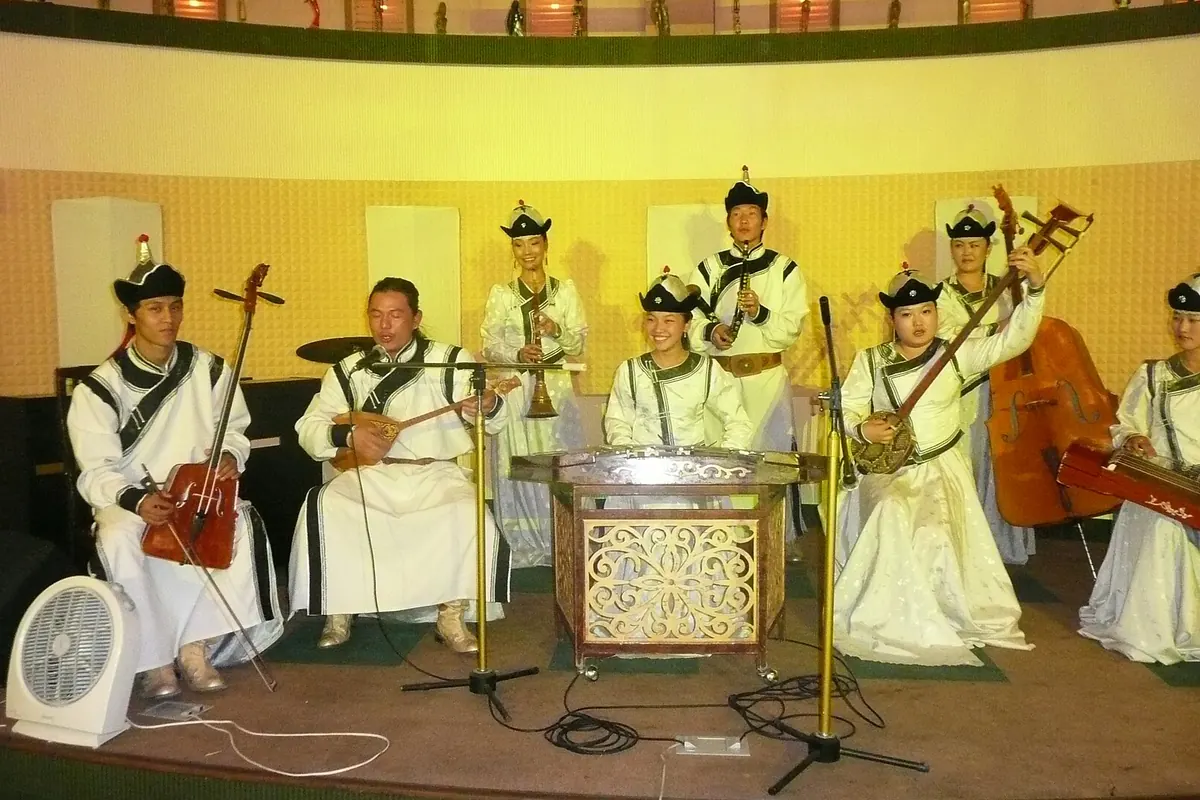
UNESCO describes khöömei as a form of singing that began in western Mongolia, in the Altai mountains. The singer imitates sounds of nature and produces two distinct vocal sounds at the same moment: a continuous drone, and above it a melody of harmonics. No instrument is involved. Wikipedia describes overtone singing in Mongolia as treated almost like an instrument, with its own ways of breathing and breath held in the chest. The effect is that a single voice sounds like two, one steady and low, one thin and bright. Listen for the drone first, and for the melody a few seconds later.
What the word means
According to UNESCO, khöömei literally means pharynx, and the art is believed to have been learned from birds, whose spirits are central to shamanic practices. You can take that as history or as poetry, but it points at the aim of the tradition: the performer imitates sounds of nature. That aim is why the result can sound so unlike the singing that concert halls usually offer, and why the first hearing often surprises people.
Two main styles
UNESCO groups the many techniques used in Mongolia into two styles. In both, the drone comes from very taut vocal cords, and the melody is shaped by the size and form of the mouth cavity: opening and closing the lips and moving the tongue. The difference lies in which part of the sound the singer pushes forward, and it is easy to hear once you know to listen for it.
- Kharkhiraa, the deep style: a drone in a normal voice, with the undertone one octave below emphasised
- Isgeree khöömei, the whistled style: the overtones above the drone are emphasised, giving a higher whistle
More styles, named by where the sound seems to come from
Beyond those two, Khalkha singers have named further styles. Several are named for the part of the body that seems to shape the sound: a melodic or lyrical style, one made with the lips, one with the palate, one with the nose, one in the throat and one in the chest cavity. One more, named türlegt, combines khöömii with long song. A listener in a hall will not tell all of these apart, and nobody expects you to. It is enough to notice that khöömei is a family of techniques and not a single sound.
Where it was sung
Khöömei is a nomads' art. UNESCO records it at occasions from grand state ceremonies to festive household events, and it is also sung during herding and inside the yurt to lull babies to sleep. UNESCO also notes that khöömei features prominently at Naadam, the national festival of wrestling, archery and horse racing. The concert stage is the recent setting, not the original one. That helps with expectations: a stage item is one polished version of something that was sung in a tent, across a pasture, or to a child.
How it is learned
Traditionally, khöömei is transmitted orally from bearer to learner, or from master to apprentice. Learning is by ear and by example, which fits an art whose key movements happen inside the mouth. The tradition rests on teachers and years of practice. That is a good reason to treat a stage performance as the work of trained specialists, and not as a party trick that anyone will pick up in an evening.
Khöömei, Tuva and the wider Altai
Throat singing is shared across the Altai region. It is practised in Tuva, Mongolia, Inner Mongolia and Altai, and Tuvan singers have their own names for styles, such as sygyt for the whistled sound and kargyraa for a deep, growling one. A related Mongolian art, the tsuur, blends a wooden pipe with the singer's throat to make a drone and a whistle; UNESCO lists it as needing urgent safeguarding. If you hear a Tuvan word in a Mongolian programme, you are in the same family of sounds.
Beside the long song
Khöömei can share a programme with the Mongolian long song, and the two make a useful contrast. Long song is a lyrical chant with abundant ornament, falsetto and a very wide vocal range. Khöömei is steadier and layered, a drone with a melody on top. One named style, türlegt, joins them in a single piece. If a programme includes both, listen to how long song spreads a few words across minutes while khöömei holds still and lets the harmonics move. The two arts come from the same pastoral world, and both survive because singers teach them person to person.
Read next: Urtiin duu: the Mongolian long song
Words you may hear
A handful of terms come up in programme notes and in conversation about throat singing, and knowing them makes the evening easier to follow. Khöömei is the art itself, and the word means pharynx. The two styles below are the ones UNESCO names, and türlegt is the style that joins khöömii to long song. Morin khuur is the horsehead fiddle that often shares a stage with the singer, and tsuur is the related pipe art that borrows the throat for its drone.
- Khöömei: the art of throat singing
- Kharkhiraa: the deep style
- Isgeree khöömei: the whistled style
- Türlegt: khöömii combined with long song
- Tsuur: a wooden pipe played with the throat
How to listen in the hall
Start with the drone. Let your ear settle on the low, steady note, then listen for the thin bright melody moving above it. When the singer changes style, the drone may drop into a growl or the melody may sharpen into a whistle. If the second sound is hard to find, close your eyes for a few seconds, because some listeners find the harmonics come forward once they stop watching the mouth. Give it a minute before you decide it is not there, and if you have already heard a recording at home, and remember that a recording and a room are different, so the melody may take longer to find.
Who this isn't for
If you want a concert of nothing but throat singing, this is not that: khöömei is one of several arts in a programme that also has instruments, dance and contortion. It is also the wrong place to learn the technique, which needs a teacher and a lot of time. And if unusual vocal sounds are not for you, a drone with a whistle above it can take a minute to like, so read this guide before the show and not during it.
Frequently asked questions
What is khöömei?
It is Mongolian throat singing, in which one singer produces a drone and a melody of harmonics at the same moment. It began in the Altai mountains of western Mongolia, and the word itself means pharynx.
Is it the same as Tuvan throat singing?
They are closely related. Throat singing is shared across Tuva, Mongolia, Inner Mongolia and Altai, though each region uses its own names for the styles, such as sygyt and kargyraa in Tuva.
How does one singer make two notes?
The drone comes from very taut vocal cords. The melody comes from changing the shape and size of the mouth cavity, with the lips and tongue, to bring out harmonics above the drone.
Is khöömei on UNESCO's list?
Yes. UNESCO added the Mongolian traditional art of Khöömei to its Representative List in 2010, as part of humanity's intangible heritage, and describes it as an art that began in the Altai mountains.
Will the show include throat singing?
Throat singing is one of the arts the show is sold on, alongside instruments, dance and contortion. Programmes change from date to date, so the exact pieces and singers vary.
What are the two main styles?
Kharkhiraa is the deep style, with an undertone an octave below the drone. Isgeree khöömei is the whistled style, with overtones emphasised above it. Both rely on a taut drone.
Sources